Soru 1
Soru arşivi yükleniyor…
Soru arşivi yükleniyor…
Sorular yükleniyor…
Sınav ve konu sorularıyla çalış. Cevabını kontrol et, zorlandığın soruları kaydet ve yeniden çöz.
229 sorunun metninde arama yapabilirsin.
Diğer 3 görselli soruları kendi sayfalarında çözebilirsin.
İlerleme yükleniyor…
Bir seçeneği işaretlediğinde cevap gösterilir. Klavyede Tab ile sorulara, ok tuşlarıyla seçeneklere geçebilirsin.
Soruyu oku ve A–E arasından cevabını seç. Seçiminden sonra doğru cevap gösterilir.
İlerleme yükleniyor…
 Görseli tam boyutta aç ↗
Görseldeki doğru seçeneğin harfini işaretle.
Sonraki görselli soru ↓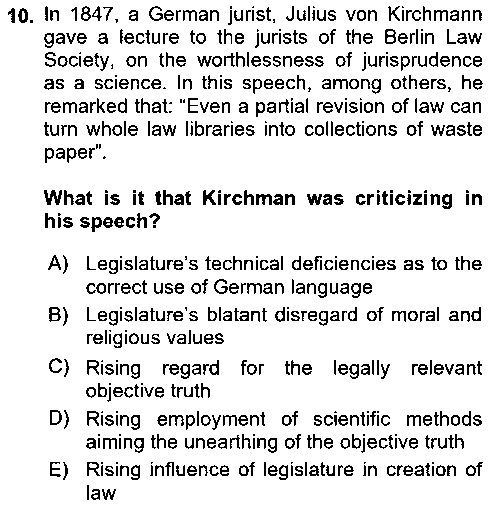 Görseli tam boyutta aç ↗
Görseldeki doğru seçeneğin harfini işaretle.
Sonraki görselli soru ↓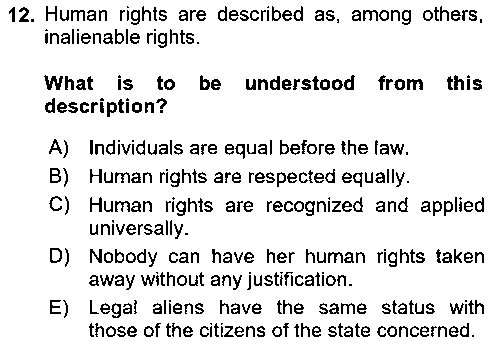 Görseli tam boyutta aç ↗
Görseldeki doğru seçeneğin harfini işaretle.
Kendi cevabını düşün, sonra yayımlanmış cevapla karşılaştır. Değerlendirmeyi sen yaparsın.
İlerleme yükleniyor…
Although there are numerous definitions, a standard definition that contains the most significant elements would read as follows: “law is a set of rules which a particular country or community recognizes as regulating the actions of its members and which it may enforce by the courts.”
Cevabın yayımlanmış cevapla uyuştu mu?
The shape, material, size, weight. Any qualities that would/could affect the outcome of a given situation in any way are regulated by law so that they are fair. In this example, according to the law, the ball has to be; • spherical • made of leather or other suitable material • of a circumference of not more than 70 cm (28 ins) and not less than 68 cm (27 ins) • not more than 450 g (16 oz) and not less than 410 g (14 oz) in weight at the start of the match • of a pressure equal to 0.6 – 1.1 atmosphere (600 – 1,100 g/cm2 ) at sea level (8.5 lbs/sq in – 15.6 lbs/sq in)4
Cevabın yayımlanmış cevapla uyuştu mu?
A legal system consists of not only substantive rules, but also it contains rules regarding the ways in which a right can be used or obtained. Such rules define the conditions within which a right can be claimed, which are called procedural rules. The rule that regulates the substitution procedure in a game is a good example.
Cevabın yayımlanmış cevapla uyuştu mu?
By declaring a legal action null and void an act performed in violation of law is rendered ineffective, or devoid of legal effect. If a legal act is void, this means that it was never in the eyes of the law a valid act. Indeed, such a legal act is regarded as “dead” from the beginning, and it is regarded as nullity. If a marriage is due to some defect (marriage before an unauthorized person, for example) existing at the time the marriage was celebrated is null and void, it will be non-existent meaning that it will produce no legal effect whatsoever. Unlike the cases of being void ab initio, in the instances of voidability, it is up to the parties to decide whether or not they wish to nullify the effect of a legal act.
Cevabın yayımlanmış cevapla uyuştu mu?
• Law is a system or set of rules. These rules are general, universally applicable to all cases that are within the confines of a particular rule; and finally, legal rules are predictable. • Legal rules are binding • Collective enforcement of law is ensured by an authority, say, police or court; • Depending on the legal tradition laws man made either by the legislature or judges or both.
Cevabın yayımlanmış cevapla uyuştu mu?
A legal system provides remedies if the precepts of the legal system are not followed or broken. Law imposes a restraint on our liberty in order to guarantee a peaceful order among the members of society. This is the first function of law, i.e. establishment and preservation of order in a society.
Cevabın yayımlanmış cevapla uyuştu mu?
Justice is not synonymous with law. It is, therefore, possible for a law to be called unjust. In general terms, justice is regarded as a moral ideal that law seeks to uphold, and it is a challenging task ascertaining what is just and unjust in a particular situation.
Cevabın yayımlanmış cevapla uyuştu mu?
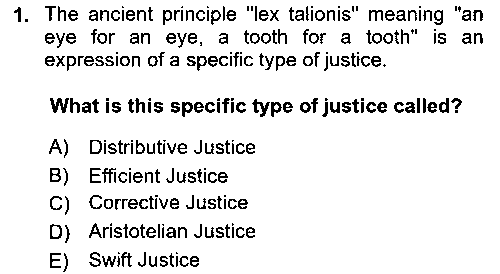
Justice must be a type of mean, namely, finding a proper balance between two extremes: between excess and deficiency. So, for Aristotle justice is a balancing act, a fair mean. Accordingly, he argues that justice consists of treating the equal equally and the unequal unequally, which is reflected in the motto of justice: ‘treat like case alike and unlike cases differently’. This idea of justice rests on the idea of proportionate equality, which implies objectivity and neutrality in judicial-decision making, the eyes of justice are blind.
Cevabın yayımlanmış cevapla uyuştu mu?
Corrective justice, in simple terms, is the justice of courts, which seeks to remedy and redress of crimes or civil wrongs. If, for example, a crime has been committed, punishment of the offender would serve corrective justice, in other words, re-establishing justice that has been damaged by a criminal offence.
Cevabın yayımlanmış cevapla uyuştu mu?
Distributive justice, which concerns giving each according to his desert or merit in the best interest of society. In essence, distributive justice means that political office or money to be apportioned in accordance with merit. Distributive justice concerns the just distribution of goods, benefits, and burdens in society.
Cevabın yayımlanmış cevapla uyuştu mu?
Legal positivists take their view of law from positive science. Law is studied on an objective and empirical basis. The question is not what law ought to be, but rather what actually law is. Only laws on the statute books and other written forms can be considered as law since they have an empirical form. Consequently, according to this view, the function of a judge is mechanical: it is simply to apply the objective.
Cevabın yayımlanmış cevapla uyuştu mu?
The natural law view has a moral (or “natural justice”) dimension, in that it seeks to define law not simplyas it is (i.e. in its empirical form) but also how it ought to be, that is, in line with “morally” correct or just behaviour. According to this view of law, whatever positive law may provide, there is always a set of moral norms dictating human behaviour.
Cevabın yayımlanmış cevapla uyuştu mu?
• The Code of Hammurabi • The law of the Athenian statesman Solon • Twelve tables • Corpus Juris Civilis • Napoleonic Codification Movement
Cevabın yayımlanmış cevapla uyuştu mu?
• A fairly clear demarcation between legal institutions (including adjudication, legislation, and the rules they spawn), on the one hand, and other types of institutions, on the other; legal authority in the former exerting supremacy over political institutions. • The nature of legal doctrine which comprises the principal source of law and the basis of legal training, knowledge, and institutional practice • The concept of law as a coherent, organic body of rules and principles with its own internal logic • The existence and specialized training of lawyers and other legal personnel
Cevabın yayımlanmış cevapla uyuştu mu?
• Law must be accessible and so far as possible intelligible, clear and predictable; • Questions of legal right and liability should be ordinarily resolved by application of law and not the exercise of discretion; • Laws of the land should apply equally to all, save to the extent that objective differences justify differentiation; • Ministers and public officers at all levels must exercise the powers conferred on them in good faith, fairly, for the purpose for which the powers were conferred, without exceeding the limits of such powers and not unreasonably; • Law must afford adequate protection of fundamental human rights; • Means must be provided for resolving, without prohibitive cost or inordinate delay, bona fide civil disputes which the parties themselves are unable to resolve; • Adjudicative procedures provided by state should be fair; • The rule of law requires compliance by the state with its obligations in international law as in national law
Cevabın yayımlanmış cevapla uyuştu mu?
Twelve Tables are the earliest written sources of Roman law, which is the initial source of the civil law tradition. The term civil law derives from the Latin ius civile meaning the law applicable to all Roman citizens. Its origins and basic model are to be found in the compilation and codification of Roman law under Justinian in the sixth century A.D, which in the sixteenth century came to be known as Corpus iuris civilis, which can be translated as “Body of Civil Law”. This compilation consists of three books: the Digest, Codex, and Institutes. These books contain rules regarding the law of persons, the family, inheritance, property, torts, unjust enrichment, and contracts and finally the remedies by which interests protected by the law are judicially protected.
Cevabın yayımlanmış cevapla uyuştu mu?
• It is uncodified; • It is largely based on precedent and case law; • It is developed from customs and decisions made by judges; • It is not made by Parliament.
Cevabın yayımlanmış cevapla uyuştu mu?
• The common law is essentially unwritten, but recently legislation has started to play a more significant role among the sources of law in the common law jurisdictions too. • The common law is casuistic: components of the legal body are cases, rather than abstract norms. It is, therefore, no surprise that legal education in the common law jurisdictions based on “reading cases”. • The doctrine of precedent is the supreme principle of the common law. The doctrine of precedent means that is binding for other courts and that the judgments of higher courts are binding on those lower in the judicial system. The rationale for this principle is, among others, the concerns of constancy, predictability, and objectivity, which are objectives of any legal system that seeks justice among its subjects. • Trial by jury for both criminal and civil cases. This is, indeed, one of the most remarkable features of the common law. In a jury trial, the jury decides on the facts of the case; the judge determines the law.46 One important aspect of the trial by jury is its emphasis on oral argumentation and rhetoric. In the civil law tradition, however, written argument prevails.
Cevabın yayımlanmış cevapla uyuştu mu?
• Independence: In the exercise of their judicial functions, judges shall be independent of all external authority or influence. They shall refrain from any activity or membership of an association, and avoid any situation, that may affect confidence in their independence; • Impartiality: Judges shall exercise their functions impartially and ensure the appearance of impartiality. They shall take care to avoid conflicts of interest as well as situations that may be reasonably perceived as giving rise to a conflict of interest. • Integrity: Judges’ conduct must be consistent with the high moral character that is a criterion for judicial office. They should be mindful at all times of their duty to uphold the standing and reputation of the Court.
Cevabın yayımlanmış cevapla uyuştu mu?
• statutes (leges), • enactments of the plebeians (plebiscita), • resolves of the senate (senatus consulta), • enactments of the emperor, • edicts of those who have an authority to issue them, • the answers of those learned in the law (responsa prudentium)
Cevabın yayımlanmış cevapla uyuştu mu?
The sources of law in EU are based on the distinction of primary and secondary legislations. Primary legislation is made from the constitutive Treaties, international agreements and general principles established by the Court of Justice of European Union. Secondary legislation is made from all the acts recognized by EU law. The secondary sources of EU law are regulations, directives, decisions, recommendations and opinions.
Cevabın yayımlanmış cevapla uyuştu mu?
The sources of law of Turkish law ordered in such a way from top to down may be listed as follows: • The Constitution • Statutes • International treaties
Cevabın yayımlanmış cevapla uyuştu mu?
• democracy, • secularism, • commitment to Atatürk nationalism, • the rule of law, • respect for human rights, and • social state
Cevabın yayımlanmış cevapla uyuştu mu?
A certain practice could be regarded as law if the following requirements are cumulatively met: • A custom must have been existed for a long time; • It must have been followed continuously; • It cannot be abandoned; • It cannot be interrupted; • It must be reasonable in nature; • It must not be in contraction with the existing canon of law.
Cevabın yayımlanmış cevapla uyuştu mu?
• Horizontal dimension: captures the phenomenon that in modern society law increasingly spread its reach and it now regulates a wide range of social activities. Law has spread into areas that were formerly considered private and beyond the reach of law. Aspects of domestic and family relations are, for example, now regulated by law. • Vertical dimension: concerns the expansion of increasingly detailed normative standards.In England have been, for instance, more than 3000 new offences in the last 15 years created.
Cevabın yayımlanmış cevapla uyuştu mu?
SIK SORULAN SORULAR
Bu derste 40 çoktan seçmeli, 3 görselli ve 189 kısa cevaplı soru bulunuyor. Her soru türü en fazla 25 soruluk sayfalara ayrılır.
Çoktan seçmeli ve görselli sorularda bir seçeneği işaretlediğinde doğru cevap gösterilir. Kısa cevaplı sorularda önce cevabını düşün, sonra kaynak cevabı açıp kendini değerlendir. Zorlandığın soruları yeniden çalışabilir, ilerlemeni aynı tarayıcıda sürdürebilirsin.
Hayır. Yılı ve sınav türü doğrulanabilen kayıtlarda bu bilgi soru kartında gösterilir. Arşiv, tüm yılların eksiksiz resmî sınav kitapçığı olarak değerlendirilmemelidir.