Görsel soru 1
Görsel soru 1
 Görseli tam boyutta aç ↗
Görseldeki doğru seçeneğin harfini işaretle.
Sonraki görselli soru ↓Soru arşivi yükleniyor…
Sorular yükleniyor…
Sınav ve konu sorularıyla çalış. Cevabını kontrol et, zorlandığın soruları kaydet ve yeniden çöz.
163 sorunun metninde arama yapabilirsin.
Diğer 3 görselli soruları kendi sayfalarında çözebilirsin.
Soruyu oku ve A–E arasından cevabını seç. Seçiminden sonra doğru cevap gösterilir.
İlerleme yükleniyor…
Görseli tam boyutta aç ↗Görseldeki doğru seçeneğin harfini işaretle.
Sonraki görselli soru ↓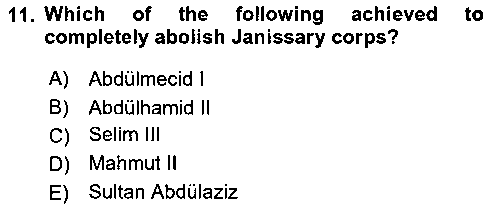 Görseli tam boyutta aç ↗
Görseldeki doğru seçeneğin harfini işaretle.
Sonraki görselli soru ↓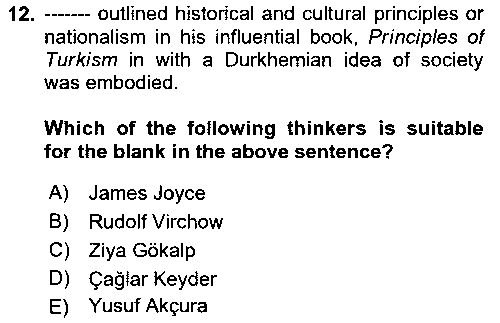 Görseli tam boyutta aç ↗
Görseldeki doğru seçeneğin harfini işaretle.
Kendi cevabını düşün, sonra yayımlanmış cevapla karşılaştır. Değerlendirmeyi sen yaparsın.
İlerleme yükleniyor…
Politics is the name of the social institution, but an important and functional institution in the reproduction of society. It fills a place within social totality together with other social instutitons, either determining them or determined by them, but in the last instance, it is politics that decides the outcome whether it is a question of religiosity, of economy, and of social. Every politics includes a value-laden act. Politics in action means subjects, for politics is actualized through subjects, to put it boldly, politics in action requires subjects, who are politically motivated individuals, groups, strata and classes, and hence become “political subjects.”
Cevabın yayımlanmış cevapla uyuştu mu?
Subjectivization is a process the subject becomes itself, but the moment subject accepts itself as it is, an objective crack appears between subject and its representation.
Cevabın yayımlanmış cevapla uyuştu mu?
Kulturkampf (“cultural war or struggle”) is a specific term that indicates a specific period (1871-1887) in German history where state tried to gain dominance over church in daily life, especially in marriage and contract issues. The appearance was illusionary; this was not a conflict between “Protestant State” and “Catholic Church” but about who was going to decide even on tiniest trivial matters in daily life, and that political power, a central authority is executive on every issue in What social life without exemption.
Cevabın yayımlanmış cevapla uyuştu mu?
The cultural struggles are important aspects of Turkish political life since the political is always mediated through cultural and ideological practices, and in return, it mediates them.
Cevabın yayımlanmış cevapla uyuştu mu?
History makes society, gives its uniqueness, and in that sense, only particular historicities differ societies from each other, and then later every society becomes a part of universal history according to its share in the ruling dynamic of historical development. History, moreover, is a persistent background to everything that happens within a society. In this sense, Joyce was right: no escape is possible from history, and thus in this sense history becomes fate.
Cevabın yayımlanmış cevapla uyuştu mu?
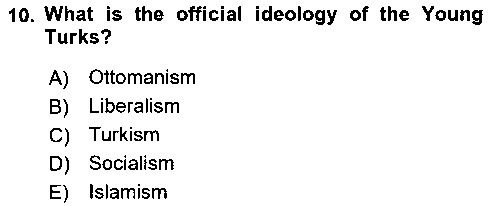
Islamism, Nationalism and Ottomanism, as Yusuf Akçura had formulated, were three modern ideologies that were employed by both state and intelligentsia to save the Ottoman Empire, which was, then rapidly declining
Cevabın yayımlanmış cevapla uyuştu mu?
Socialism especially after 1960 Coup, was rapidly progressing. Socialism was mostly a combination of narodnik populism and an economic program of independent development.
Cevabın yayımlanmış cevapla uyuştu mu?
Narodnik, (Russian: “Populist”), member of a 19th century socialist movement in Russia who believed that political propaganda among the peasantry would lead to the awakening of the masses and, through their influence, to the liberalization of the tsarist regime. Because Russia was a predominantly agricultural country, the peasants represented the majority of the people (narod): hence the name of the movement, narodnichestvo, or “populism”.
Cevabın yayımlanmış cevapla uyuştu mu?
The People’s Houses, The Village Institutes and The Imam-Hatip Schools are three different cultural-social and educational organizations through which Turkey’s quest for Westernization and the reaction to it, can be examined.
Cevabın yayımlanmış cevapla uyuştu mu?
The People’s House was home for secular, urbanite citizen, The Village Institutes was there to create the enlightening/enlightened pioneer for rural people, The İmam-Hatip Schools aimed to form a religious, pious person to save the tradition and religious sentiment against destructive outcomes of westernization. The formation of individuality from above through state and its apparatuses was the common theme for these three examples, but they also indicate how Turkish process of modernization advanced in different dimensions in the guidance of state.
Cevabın yayımlanmış cevapla uyuştu mu?
Power elite and its formation in Turkey cannot be examined properly without taking military elite into consideration, and not only short-term political upheavels, but also long-terms political trends and inclinations have been strongly influenced by capitalistic market, it is a necessity to look into economy as a dark horse in the political conglomerations.
Cevabın yayımlanmış cevapla uyuştu mu?
rural and poor masses was provided by army during the founding act. Later interventions in politics by the army is thus somehow “understandable”, and as result of that, it is not surprising the soldier-nation myth developed by Turkish nationalism has contributed to the normalization of the army involvements at any level.
Cevabın yayımlanmış cevapla uyuştu mu?
The weakness of Turkish political structure, lack of a strong civil society, flaws in political culture that underestimate politics and politicians in things they do, justified the army and its actions at large.
Cevabın yayımlanmış cevapla uyuştu mu?
The Turkish Army directly intervened and changed the structure of political power in 1960, 1971, 1980, 1997, 2007 and 2016, the last two (2007 and 2016) were not “successful.”
Cevabın yayımlanmış cevapla uyuştu mu?
Praetorianism: The control of a society by force or fraud, especially when exercised through titular officials and by a powerful minority.
Cevabın yayımlanmış cevapla uyuştu mu?
It is clear that in the early 70’s and 80’s there were teroristic actions by both left and right, the economic conditions were bad, high inflations made prices untouchable, public administration was chaotic, the parliament was too soft to take any decision, but both coups did not produce any positive outcome either economically or politically.
Cevabın yayımlanmış cevapla uyuştu mu?
Every student who is “lucky” enough to have a mighty teacher will begin to learn that it is economy which rules, not politics, so instead of involving in silly and petit political games, one needs to have a look at “big economic picture.” This seems to be a strong and correct argumentation, indeed it is, but partly. There is an undeniable relation between politics and economy, and there are endless debates on what comes first in the last instance, to use Althusserian concept. The third option which envisages the mutuality in relation between politics and economy does not solve any problem nor it gives an adequate explanation.
Cevabın yayımlanmış cevapla uyuştu mu?
The capitalist development in Turkey was a slow process. The early Republic was based on peasantry, which had been in a backward position then. The Marshall Plan was used to mobilise peasantry after World War II. Menderes’s Democrat Party contributed to the petit production networks. The growth of Turkish bourgeoisie and working class gained momentum after 1960. But overall, state was the main source of wealth, and controlling force over financial and productive markets.
Cevabın yayımlanmış cevapla uyuştu mu?
Throughout 80’s and 90’s the main economic tension between state and bourgeoisie was not limited to the ownership of productive activity, because the volume of production was not enought to build their corresponding spheres, so they acted accordingly, and restrained each other.
Cevabın yayımlanmış cevapla uyuştu mu?
The privatization of public economic enterprises, elimination of unions, gentrification, enormous growth of construction industry pictures a scene in which the future of Turkish politics lies.
Cevabın yayımlanmış cevapla uyuştu mu?
The first concentrates on the last century of the Ottoman Empire. The other reviews the political developments between 1923 and 1950. We need to acknowledge the serious similarities between these two periods. Reforms and modernization efforts, which started in the Ottoman Empire in particular, allowed the development of a great heritage for the republic period. In this period, when the administrative and legal system of the society, economy, and the state was transformed in a fundamental way, the staff that established the Republic were formed and a suitable ground was established for building the Republican reforms.
Cevabın yayımlanmış cevapla uyuştu mu?
If we exclusively consider the administrative structure of the Ottoman State during its classic period, the administrators representing the ruler’s authority are located at the top layer of the stratification. These are soldiers, bureaucrats, and clergymen. The other major element of the stratification system consists of the rayah (reaya). The peasants, merchants, and artisans are the components that create this layer.
Cevabın yayımlanmış cevapla uyuştu mu?
During the classical period, the economic structure of the Ottoman Empire is mainly based on agriculture. Hence, the villagers are the very basis of this structure, based on agriculture. The fact that they continue to cultivate their land and give some of the products they produce each year to the center in kind or in cash is of crucial importance in preserving the economic balances. In this structure, the peasants are not the principal owners of the land but they have the right to use the land as long as they fulfil their responsibilities. Furthermore, they can transfer this right to their children.
Cevabın yayımlanmış cevapla uyuştu mu?
The most significant signs of the disintegration of the classical order are the revolts. One of the most well-known of these is the Celali rebellions, which developed under the leadership of the rulers who lost their importance and values in the system. With these rebellions between 1556-1650, the Sipahi took action in order to compensate for their loss. On the other hand, the Patrona Halil uprising of 1730 represents the reactions to the capitalization process in agriculture. In other words, Patrona Halil rebellion is a clear reaction of the traditional urban production system to the big investments and the investor class that were created with capitalization.
Cevabın yayımlanmış cevapla uyuştu mu?
Firstly, reform initiatives were mainly launched in the military field. Secondly, the reform initiatives that were launched in the military field were implemented in other problematic areas.Thirdly, we may generally observe an effort towards the centralization in the reform initiatives launched by Selim III. Forthly, every reform initiative primarily aims to restore the existing order.
Cevabın yayımlanmış cevapla uyuştu mu?
SIK SORULAN SORULAR
Bu derste 0 çoktan seçmeli, 3 görselli ve 163 kısa cevaplı soru bulunuyor. Her soru türü en fazla 25 soruluk sayfalara ayrılır.
Çoktan seçmeli ve görselli sorularda bir seçeneği işaretlediğinde doğru cevap gösterilir. Kısa cevaplı sorularda önce cevabını düşün, sonra kaynak cevabı açıp kendini değerlendir. Zorlandığın soruları yeniden çalışabilir, ilerlemeni aynı tarayıcıda sürdürebilirsin.
Hayır. Yılı ve sınav türü doğrulanabilen kayıtlarda bu bilgi soru kartında gösterilir. Arşiv, tüm yılların eksiksiz resmî sınav kitapçığı olarak değerlendirilmemelidir.