Görsel soru 1
Görsel soru 1
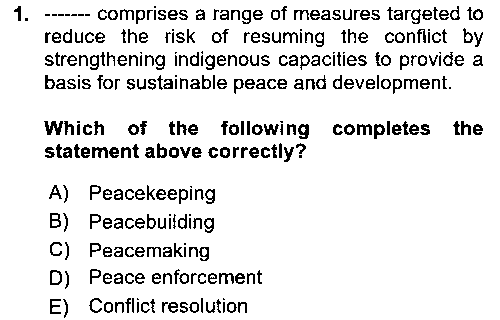 Görseli tam boyutta aç ↗
Görseldeki doğru seçeneğin harfini işaretle.
Sonraki görselli soru ↓Soru arşivi yükleniyor…
Sorular yükleniyor…
Sınav ve konu sorularıyla çalış. Cevabını kontrol et, zorlandığın soruları kaydet ve yeniden çöz.
171 sorunun metninde arama yapabilirsin.
Diğer 3 görselli soruları kendi sayfalarında çözebilirsin.
Soruyu oku ve A–E arasından cevabını seç. Seçiminden sonra doğru cevap gösterilir.
İlerleme yükleniyor…
Görseli tam boyutta aç ↗Görseldeki doğru seçeneğin harfini işaretle.
Sonraki görselli soru ↓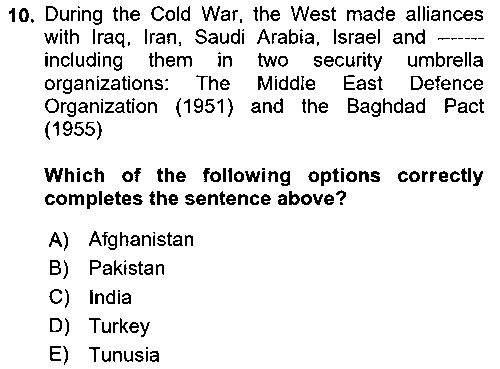 Görseli tam boyutta aç ↗
Görseldeki doğru seçeneğin harfini işaretle.
Sonraki görselli soru ↓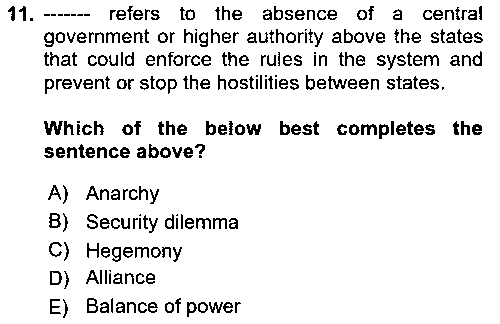 Görseli tam boyutta aç ↗
Görseldeki doğru seçeneğin harfini işaretle.
Kendi cevabını düşün, sonra yayımlanmış cevapla karşılaştır. Değerlendirmeyi sen yaparsın.
İlerleme yükleniyor…
The main problem in the security dilemma is that although all actors in the international system aspire for security, the interaction of their efforts creates general insecurity. When a state moves its military expenditures from offensive to defensive weapons, it hopes to solve the security dilemma by increasing its security without decreasing its opponent.
Cevabın yayımlanmış cevapla uyuştu mu?
Collective security has been criticized from different perspectives. First, nuclear weapons and mutually assured destruction (MAD) weaken the deterrent effect because they make it impossible to use predominant force against a nuclear-capable aggressor. Secondly, collective security organizations (the League of Nations and the United Nations) have failed to prevent aggression in the 1930s and the postwar era. Thirdly, collective security is hard to implement in an anarchical world of sovereign nation-states because collective security forces state to equate national security with international security. It is almost impossible to convince states to believe that an attack on anyone is an attack on all. Furthermore, when states are attacked, they are forced to give up their sovereign right to use of force because they should ask collective security organization. In addition, it is highly unlikely that in a collective security system, states may not punish friends as well as enemies and powerful countries as well as weak ones. Lastly, collective security makes the states believe that only in two conditions, use of force is a legitimate form of aggression. The first condition is that collective security organization authorizes the use of force. Second condition is self-defense, which is a legitimate use of force.
Cevabın yayımlanmış cevapla uyuştu mu?
Peace can be defined in two ways. Negative peace focuses on reducing, eliminating, and ending all physical violence as well as war. It is the absence of direct violence. Positive peace means negative peace plus the absence of structural and cultural violence.
Cevabın yayımlanmış cevapla uyuştu mu?
The Responsibility to Protect (R2P) doctrine represents a major paradigmatic transformation in human security paradigm. Humanitarian intervention has evolved into a normative innovative concept that transforms international law and politics. It should be emphasized that R2P is one of the tools through which international security is provided to ensure the protection of civilians but it does not construct the whole of human security. R2P came into existence to offer a solution to one of the worst issues in international security – mass atrocities and gross human right violations. R2P refers to third-party initiatives and pre-emptive measures to prevent violent conflicts to escalate.
Cevabın yayımlanmış cevapla uyuştu mu?
Conflict intervention methods consist of the following: Conflict prevention, conflict management, conflict settlement, conflict resolution, conflict transformation, and conflict prevention.
Cevabın yayımlanmış cevapla uyuştu mu?
If violent conflict prevention fails or the third-party interveners do not apply preventive measures, the house is on fire. As a result, the interveners take necessary steps to prevent existing fire from spreading with reactive measures. During the collapse of the former Yugoslavia, the UN Protection Force (UNPROFOR) reactively responded to prevent the fire from spreading.
Cevabın yayımlanmış cevapla uyuştu mu?
The world has been obsessed with the issue of security during the 20th century because of the two world wars and the proxy wars of the Cold War.
Cevabın yayımlanmış cevapla uyuştu mu?
ISS is defined as “the study of the threat, use, and control of military force.” It investigates how conditions make the use of force more likely and how the use of force affects individuals, states, and societies. It addresses the specific policies that states embrace in order to prepare for, prevent, or engage in war.
Cevabın yayımlanmış cevapla uyuştu mu?
Collective security is rested on Alexandre Dumas’ d’Artagnan and his fellow Musketeers motto: “One for all, and all for one!” The Musketeers motto has following rules in collective security: 1. All actors in international system should become a member in a collective security organization (CSO). If all actors join a single unifying alliance, they acquire enough power to keep international peace and assume international legitimacy. 2. All threats and challenges to peace must have a common attention from everyone. If an aggressor is not stopped, the conflict will have spill-over effects to spread to regional and international system. As a result, an attack on any one state must be regarded as an attack on all states. 3. If international peace and stability is threatened, international community via the CSO act timely with appropriate acts including public condemnation, economic boycott, sanctions, and the use of force. 4. Members of the CSO should commit to use peaceful means to solve international conflicts. The CSO must provide necessary conflict resolution mechanisms including judicial organ, arbitration, mediation, and third-party intervention
Cevabın yayımlanmış cevapla uyuştu mu?
Informal security institutions have emerged when a security problem arises that cannot be dealt with efficiently and effectively by existing international security organizations. For example, because of the failed state of Somalia, a large international flotilla was established to fight the modern maritime piracy
Cevabın yayımlanmış cevapla uyuştu mu?
Security threats emanated from global environmental problems present four future political dilemmas: 1. Environmental threats are usually less clear-cut and direct than other security threats. They are like threats without enemies. 2. Threats such as global warming and ozone depletion are mostly perceived as longer term emergencies rather than imminent attacks and disasters. 3. Environmental threats are often accompanied by significant economic, social and political costs. Unsolved, they may lead to the creation of environmental refugees in the future. 4. They are only confronted by a globally coordinated holistic approach with political, economic, social, and educational actions
Cevabın yayımlanmış cevapla uyuştu mu?
It is possible to explain, analyze and understand the international security in six levels: • Individual level: Security for the individual. • Societal level: Security for the social group, i.e. ethnic, national, religious, linguistic, or community groups. • National level: Security for the state or nation. • Regional level: Security for the region, that is, a coherent security region. • International level: Security for the international society, the society of nations, and most states in the world. • Global level: Security for the planet Earth and space
Cevabın yayımlanmış cevapla uyuştu mu?
First, conflict is normal, inevitable and everywhere. Human beings inherently live in the conflict-laden world since the beginning of time itself. Secondly, a conflict exists at the center of all human societies and is occasionally useful. Thirdly, it is almost impossible to eliminate the conflict in its entirety but it is possible to manage the violent side of the conflict. Lastly, in some specific instances, threat and coercion can be applicable to de-escalate the conflict
Cevabın yayımlanmış cevapla uyuştu mu?
Globalization and interdependence are the two central components that have changed the nature of power as well as our understanding of security in four major ways. First, the dynamics of international security have changed the power distribution across the board. Nowadays not only the United States but also the Russian Federation, the People’s Republic of China, and the European Union are considered “big powers.” Second, the increase in the volume of global trade, international communication and travel as well as the emergence of the Industry 4.0 have created an integrated global economy and made it necessary to take into account some new actors, means, and perspectives for sustaining and promoting international security. Third, globalization and interdependence may lead to a butterfly effect in that local problems may turn into major international threats and challenges that would affect regional and global security. Finally, because there is no one institution that would act as a global government and create a just global system, globalization, in fact, functions in a way to increase international anarchy and complexity. This, in turn, heightens security concerns and calls for a creative problem-solving approach.
Cevabın yayımlanmış cevapla uyuştu mu?
It is possible to classify ISS under two main approaches: Traditionalist and Critical.
Cevabın yayımlanmış cevapla uyuştu mu?
Current global threats are caused by separatism, disintegration, fragmentation, hyper-nationalism, isolationism, ethnic and religious fanaticism, and self-sufficiency.
Cevabın yayımlanmış cevapla uyuştu mu?
The traditionalist security approaches have the following features: First, they have mostly emphasized the military aspects of security as well as the concepts such as war, defense, strategy, and geopolitics. They have focused on the problem of national security and the nation-state. Second, the traditionalist security approaches mostly choose a narrow or mono-sectoral agenda and attach priority to one sector (military), one actor (the state), and one action (the use of force). Finally, the traditionalist security approaches have a statist perspective, which is based on a scientific and objectivist understanding of knowledge.
Cevabın yayımlanmış cevapla uyuştu mu?
Buzan distinguished five models of security due to newly emerging diversity of perceived threats: • Military security, • Political security, • Economic security, • Societal security, • Environmental security.
Cevabın yayımlanmış cevapla uyuştu mu?
Environmental security deals with the maintenance of local and planetary biosphere as well as space in order to ensure continued existence of all human beings.
Cevabın yayımlanmış cevapla uyuştu mu?
Asymmetrical warfare is defined as threats outside the range of conventional warfare and attacks that are difficult to respond to in kind such as suicide bombings.
Cevabın yayımlanmış cevapla uyuştu mu?
Keith Krause, Michael Williams, Ken Booth, and Richard Wyn Jones are scholars associated with the Critical Security Studies.
Cevabın yayımlanmış cevapla uyuştu mu?
The Aberystwyth (Welsh) School, Copenhagen School, and Paris School are the main schools of thought.
Cevabın yayımlanmış cevapla uyuştu mu?
The exercise of power by states toward each other is called power politics.
Cevabın yayımlanmış cevapla uyuştu mu?
There are two main approaches of realism: classical realism that considers power politics in terms of egoism and neorealism, or structural realism, that explains power politics in terms of anarchy.
Cevabın yayımlanmış cevapla uyuştu mu?
• Politics is governed by objective laws which have their root in human nature. • The key to understanding international politics is the concept of interest defined in terms of power. • The forms and nature of state power will vary in time, place and context but the concept of interest remains consistent. • Universal moral principles do not guide state behavior, although this does not rule out an awareness of the moral significance of political action. • Moral aspirations are specific to a particular nation; there is no universally agreed set of moral principles. • The political sphere is autonomous
Cevabın yayımlanmış cevapla uyuştu mu?
SIK SORULAN SORULAR
Bu derste 0 çoktan seçmeli, 3 görselli ve 171 kısa cevaplı soru bulunuyor. Her soru türü en fazla 25 soruluk sayfalara ayrılır.
Çoktan seçmeli ve görselli sorularda bir seçeneği işaretlediğinde doğru cevap gösterilir. Kısa cevaplı sorularda önce cevabını düşün, sonra kaynak cevabı açıp kendini değerlendir. Zorlandığın soruları yeniden çalışabilir, ilerlemeni aynı tarayıcıda sürdürebilirsin.
Hayır. Yılı ve sınav türü doğrulanabilen kayıtlarda bu bilgi soru kartında gösterilir. Arşiv, tüm yılların eksiksiz resmî sınav kitapçığı olarak değerlendirilmemelidir.