Görsel soru 1
Görsel soru 1
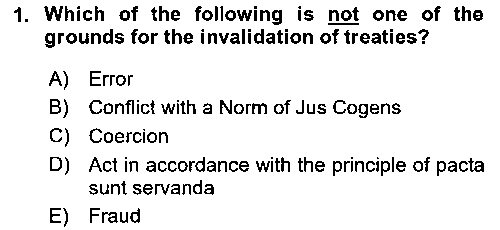 Görseli tam boyutta aç ↗
Görseldeki doğru seçeneğin harfini işaretle.
Sonraki görselli soru ↓Soru arşivi yükleniyor…
Sorular yükleniyor…
Sınav ve konu sorularıyla çalış. Cevabını kontrol et, zorlandığın soruları kaydet ve yeniden çöz.
161 sorunun metninde arama yapabilirsin.
Diğer 3 görselli soruları kendi sayfalarında çözebilirsin.
Soruyu oku ve A–E arasından cevabını seç. Seçiminden sonra doğru cevap gösterilir.
İlerleme yükleniyor…
Görseli tam boyutta aç ↗Görseldeki doğru seçeneğin harfini işaretle.
Sonraki görselli soru ↓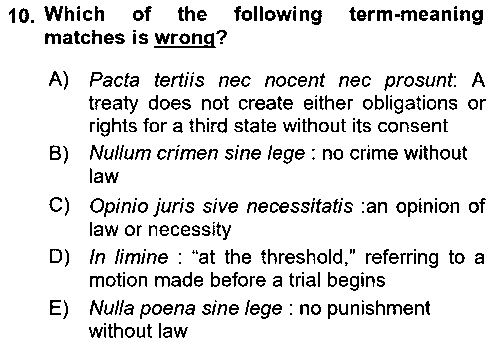 Görseli tam boyutta aç ↗
Görseldeki doğru seçeneğin harfini işaretle.
Sonraki görselli soru ↓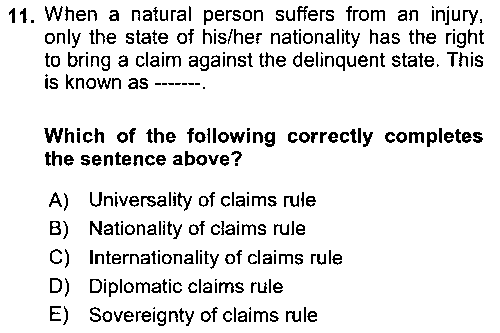 Görseli tam boyutta aç ↗
Görseldeki doğru seçeneğin harfini işaretle.
Kendi cevabını düşün, sonra yayımlanmış cevapla karşılaştır. Değerlendirmeyi sen yaparsın.
İlerleme yükleniyor…
The naturalist school and the positivist school
Cevabın yayımlanmış cevapla uyuştu mu?
The theory of monism regards that both international law and municipal law have a common underlying legal basis, which derives its origin from the law of nature and binds both States and individuals
Cevabın yayımlanmış cevapla uyuştu mu?
States adopt certain rules of international law only because they voluntarily restrict their sovereignty. The sovereignty is absolute unless a State agrees to its limitation. This is known as auto limitation theory.
Cevabın yayımlanmış cevapla uyuştu mu?
Since dualists attach significance to the sovereignty of the State will, they give primacy to municipal law over international law. Because the State is independent, it should enjoy complete liberty and exercise full sovereignty. On the other hand, monists are divided on this issue. Some monists give primacy to international law while others to municipal law.
Cevabın yayımlanmış cevapla uyuştu mu?
The theory of dualism grew out of the nineteenth-century positivist philosophy that emphasizes the will of the State as the sole criterion for establishing international rules. According to the dualist theory, international law and municipal law operate on different levels. While international law regulates mainly the relations and obligations between sovereign States, municipal law operates and regulates the relations and obligations of individuals within a State.
Cevabın yayımlanmış cevapla uyuştu mu?
The true basis of international law lies neither exclusively in natural law nor solely in the consent of States, but in variety of factors that impel States to obey the law. Most rules of international law are based on similar and complementary interests of nations. Self-interest appears to be the basic reason for compliance, and voluntary compliance generally does not need any specific enforcement.
Cevabın yayımlanmış cevapla uyuştu mu?
A large number of new independent states emerged after the Second World War and this affected the nature and orientation of international law and helped in the adoption of universal rules. New states’ contribution to international conferences and participation in the work of the UN General Assembly has helped in the growth of international law. This has further underlined the significance of international political and economic order in the international system.
Cevabın yayımlanmış cevapla uyuştu mu?
Development of modern international law can be studied under two distinct headings: development during the classical period and development since World War I.
Cevabın yayımlanmış cevapla uyuştu mu?
Critics always draw a parallel with municipal (State) law and are wary of the absence of a legislative body, the hierarchy of courts, and enforcement machinery under international law. They argue there is no machinery at the international level that is similar to a State that would make, implement, and enforce law. The breaches of international law that led to wars or armed conflicts, non-observance of treaty obligations, and other blatant violations of international law have been quoted as examples of total absence of an international legal system. Critics have also used the absence of effective sanctions as another reason for challenging its legal character.
Cevabın yayımlanmış cevapla uyuştu mu?
They believed in the primacy of customary rules and treaty rules. According to these jurists, the rules of international law and municipal law are equally binding, since both are created by the will of the State that is the source of the validity of law. In other words, it isthe will of the State that commands obedience both in municipal law and international law.
Cevabın yayımlanmış cevapla uyuştu mu?
The Kellogg-Briand Pact: A multilateral agreement condemning war. It grew out of a proposal by the French Premier, Aristide Briand, to the US government for a treaty outlawing war between the two countries. The US Secretary of State, Frank B. Kellogg, proposed a multilateral treaty of the same character. In August 1928, 15 nations signed an agreement committing themselves to peace; the USA ratified it in 1929, followed by a further 46 nations. The failure of the Pact to provide measures of enforcement nullified its contribution to international order.
Cevabın yayımlanmış cevapla uyuştu mu?
Traditional definition of international law emphasizes legal rules and principles binding upon civilized nations only in their mutual relations while the modern definition emphasizes the relations not only among states but also between states and other subjects of international law.
Cevabın yayımlanmış cevapla uyuştu mu?
A system composed solely of legal rules and principles binding upon civilized nations only in their mutual relations.
Cevabın yayımlanmış cevapla uyuştu mu?
Austin’s opposition to international law stems from his definition of law. According to Austin, law “properly so called” is the command of the sovereign, backed by a superior political authority. In other words, law is the edict issued from a determinate sovereign legislative authority that must be backed by the authority of the State. ... If the concerned rules were not issued by the sovereign authority, then they cannot be legal rules.
Cevabın yayımlanmış cevapla uyuştu mu?
Codification means “the more precise formulation and systematization of rules of international law in fields where there already has been extensive State practice, precedent, and doctrine.”
Cevabın yayımlanmış cevapla uyuştu mu?
Critics of international law argue that it differs remarkably from municipal law in many respects such as the absence of an elected legislature to frame laws, the absence of courts with compulsory jurisdiction over all disputes or the absence of an independent third-party dispute- settlement mechanism, and the lack of effective sanctions to punish those subjects (states) who break the rules.
Cevabın yayımlanmış cevapla uyuştu mu?
monism and dualism
Cevabın yayımlanmış cevapla uyuştu mu?
Countermeasures are unilateral measures adopted by a State (the ‘injured State’) in response to the breach of its rights by the wrongful act of another State (the ‘wrongdoing’ or ‘target’ State) that affect the rights of the target State and are aimed at inducing it to provide cessation or reparations to the injured State (Oxford Public International Law).
Cevabın yayımlanmış cevapla uyuştu mu?
Ubi Societas Ibi Jus is a legal maxim which means ‘where there is society, there is law’. This maxim revolves around the concept that law and society are indivisible. The maxim states that law is indispensable to every society. Maintenance of peace and harmony of a society will happen in its entirety only if there is a law for the society.
Cevabın yayımlanmış cevapla uyuştu mu?
Oliver J. Lissitzyn suggests, there are three reasons for obeying the law: self-interest, sense of moral obligation, and habit. Of these three, self- interest is probably the most basic reason for the observance of international law.
Cevabın yayımlanmış cevapla uyuştu mu?
• international conventions, whether general or particular, establishing rules expressly recognized by the contesting States; • international custom, as evidence of a gen- eral practice accepted as law; • the general principles of law recognized by civilized nations; • subject to the provisions of Article 59, judicial decisions and the teachings of the most highly qualified publicists of the vari- ous nations, as subsidiary means for the determination of rules of law.
Cevabın yayımlanmış cevapla uyuştu mu?
The ICJ will resort to the following sources for deciding a dispute before it: treaties (conventions); custom; general principles of law; judicial decisions; juristic work on international law (the teachings of publicists); principles of equity and ex aequo et bono; General Assembly and Security Council resolutions and practices.
Cevabın yayımlanmış cevapla uyuştu mu?
Ex aequo et bono means what is just and fair or according to equity and good conscience. Something to be decided ex aequo et bono is something that is to be decided by principles of what is fair and just. A decision-maker who is authorized to decide ex aequo et bono is not bound by legal rules but may take account of what is just and fair.
Cevabın yayımlanmış cevapla uyuştu mu?
Treaties, custom, and general principles of law are the main sources of international law.
Cevabın yayımlanmış cevapla uyuştu mu?
Judicial decisions and juristic work on international law fall into the category ofsubsidiary sources.
Cevabın yayımlanmış cevapla uyuştu mu?
SIK SORULAN SORULAR
Bu derste 0 çoktan seçmeli, 3 görselli ve 161 kısa cevaplı soru bulunuyor. Her soru türü en fazla 25 soruluk sayfalara ayrılır.
Çoktan seçmeli ve görselli sorularda bir seçeneği işaretlediğinde doğru cevap gösterilir. Kısa cevaplı sorularda önce cevabını düşün, sonra kaynak cevabı açıp kendini değerlendir. Zorlandığın soruları yeniden çalışabilir, ilerlemeni aynı tarayıcıda sürdürebilirsin.
Hayır. Yılı ve sınav türü doğrulanabilen kayıtlarda bu bilgi soru kartında gösterilir. Arşiv, tüm yılların eksiksiz resmî sınav kitapçığı olarak değerlendirilmemelidir.